
Ultimate Guide to Building Decking
3:13 pm
Part 1 – The Framework
You have decided to do some DIY (building a deck can be straightforward if your ground is level), but where to start with your decking project? At Park Timber we are here to help – if you want our expert advice get in touch with our team.
First thing is to decide where you want to build your deck, whether you want your deck to be raised or on the ground and which way you want the deckboards to run.
Decking projects can transform an outside are whether that is in your garden, by a log cabin or on a patio.
For more detail visit our DIY help page.
Before you can start building the deck you need to ensure the site is properly prepped.
- Measure the site according to your plan and mark this out
- Clear away any plants rocks or weeds and remove any turf – for the best results use a spirit level to check the whole area is level
- For a simple project you can lay straight on the ground using Weedtex as a control fabric.
Laying the framework:
- The timber we advise for the framework is our Sawn and Treated C16/C24, generally we would advise customers who are making a deck on ground level to use 47 x 100 size or larger (if you are doing a raised deck you will need more depth).
- Cut or purchase the frame in the required length (our Sawn and Treated timber comes in a variety of lengths), using wood screws to secure the frame.
- If you need to raise the frame for a raised deck you will need to use posts and secure them in the ground with postmix. You can then screw your framework onto these posts ensuring they are flush to the top.
- Once you have completed the framework, you can insert your joists these should run the opposite way to your deckboards. We recommend you run joists every 400mm and either nail or screw these in.
- For additional strength we advise to add in noggins, these are pieces of timber which should be staggered between your joists.
- If your joists are not long enough you can extend these by placing an off cut across the join and then screwing this to both ends of the timber.
- If you had envisioned your deck to be an extension on from a building we have express nails available to secure your framework into brickwork.
Part 2: Laying the deck
Your framework is now built and secured, so time to start laying your deck.
We advise to place six boards in position at any one time, leaving a gap of approximately 5mm between each board (you can use a nail to ensure the gaps remain the same).
The gap of 5mm provides ventilation for the boards and allows for expansion in wet weather. To secure the boards to the deck use decking screws, these are coated to ensure they do not rust and spoil the timber.
Deck screws are available in 200, 500 or 1000 units. We advise to pre-drill the screw holes to minimise the risk of splitting the wood.
You should secure the ends of the boards before securing the centre of the board.
If you have decided on a decking area larger than the boards, the boards will need to be staggered ensuring that all joins are done over a joist so you can secure both the boards to the framework.
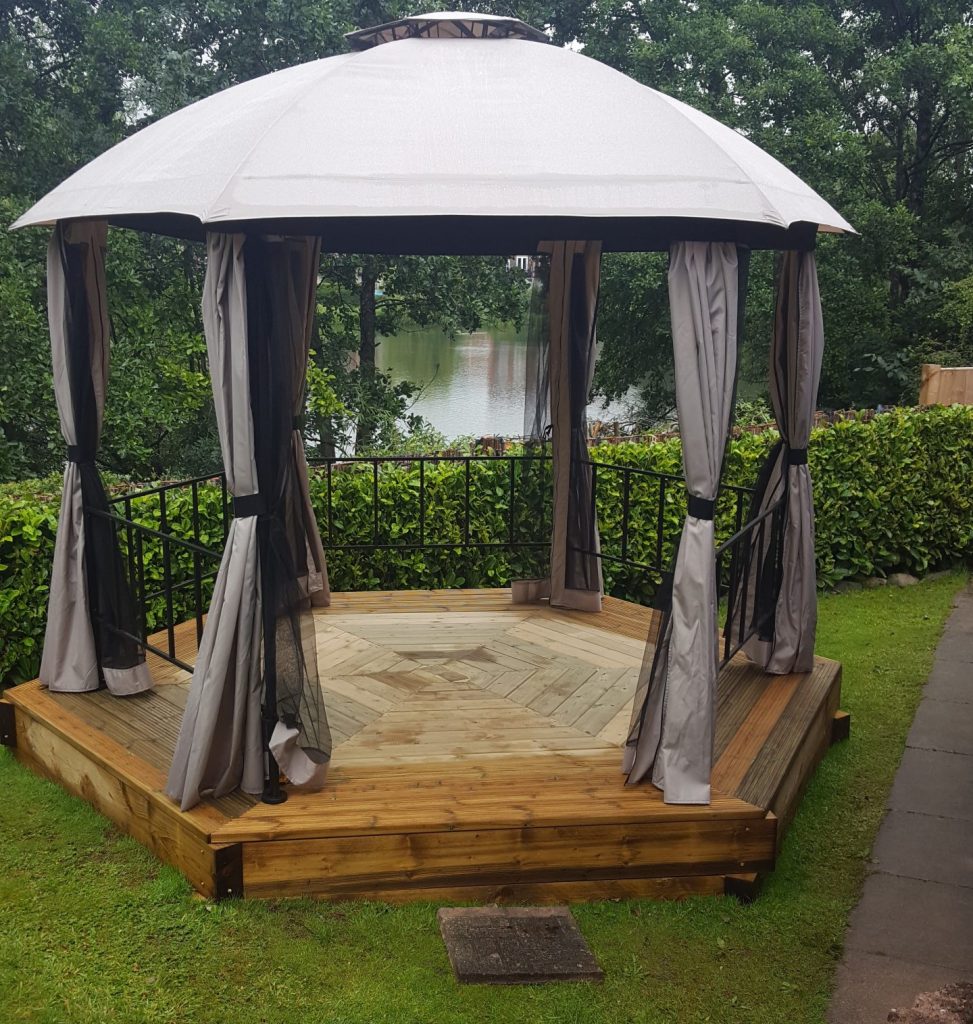
Finishing touches count! So, when you have secured all deck boards it is time to finish off the edge that is visible. This can be done by an addition deck board running the length of the outer frame. Again, screw the ends in place before securing the centre.
You don’t have to lay your decking in straight lines you can lay the boards diagonally or even create a herringbone effect. Give us a call if you want to be more adventurous and we can talk through the options.
Decking Blog Part 3: Maintenance
Now you have laid the deck – you can start to think about additions, whether that is the look of the boards or the entirety of the deck.
Timber is a living product and therefore general maintenance will be required to keep your deck looking tidy. If your preference is to leave the timber boards their natural colour, we would advise that you power wash your deck annually, this will remove any grime and keep the deck looking smart.

Treating the deck boards
We stock Saicos decking oil this comes in a variety of colours and a couple of different sizes. The oil is a premium oil for long term protection. The natural vegetable oils penetrate the woods surface preventing it from cracking, peeling, or flaking. Importantly the wood can continue to breathe so moisture from dirt and the elements can evaporate naturally. We advise to refrain from painting the deck until at least 2-3 months after laying, the deck needs to be completely dry. The easiest way to know if your deck is completely dry is to apply the oil to a small area of the deck, the oil should remain clear, if it goes cloudy the timber is not dry.
For maintenance of the deck boards, we have a wash care product that is a water additive with plant soaps and natural care components. It cleans gently and thoroughly to leave a streak free surface. It freshens up the surface and helps to make it dirt repellent.
We also have a Ecoline refresher which is recommended for usage every 3-6 months, to regenerate and refresh your decking area, again this product helps to make the surface of your decking dirt repellent and extremely wear resistant.
Decking boards can be slippery and therefore if slipping on steps or a ramp is a concern we have anti – slip plates available that can be screwed onto the boards.

Framing your deck
We have a variety of items that could help frame your decking. From panels, to rails, to spindles, to decking rope. Each provides a unique finish and can complement your outside area.
Wooden spindles are a great way to close the deck off if at height but also add a different dimension to the deck even if it is only used on an area of the decking. For a more contemporary look you can use metal spindles which are also low maintenance. The spindles are usually completed by a wooden hand a base rail.
Panels are an easy way to close off your deck and an alternative to spindles. We have a cross hatch panel and sunburst panel in our range. Similar to spindles these add a different dimension.
For a closed off deck that does not ruin views our glass balusters provide a great way to modernise you deck while also being able to enjoy the garden beyond.

Now you’re ready to get started on building your own high quality decking. If you would like some more information or specific advice on your set up, please get in touch with our team.